In 2023, President Xi Jinping solemnly proposed the Global Civilization Initiative, emphasizing that tolerance, coexistence, exchanges, and mutual learning among different civilizations play an irreplaceable role in advancing humanity’s modernization process and making the garden of world civilization flourish, as the future of all countries is closely connected nowadays. To promote inter-civilization dialogue and cooperation, to implement the spirit of the Ninth ROK-Japan-China Trilateral Summit, and to enhance people-to-people exchanges among Asian youths, the CAMPUS Asia+ Social Innovation Forum was held at Peking University from July 4 to 6, 2025. Hosted by the School of International Studies at Peking University, the forum invited over 40 faculty members and students from Waseda University, Japan; Korea University, ROK; Nanyang Technological University (NTU), Singapore; and Peking University, China. Under the theme “Inclusive Development in Asia: Social Innovation and Intercultural Dialogue,” they engaged in multifaceted discussions and in-depth exploration of the challenges and future cooperation for socially inclusive development in Asia.

(Figure 1. Group Photo of Participants)
Through specialized lectures, field research, group discussions, and results presentations, the forum deepened connections among Asian youths in cultural exploration and in awareness of their responsibilities for sustainable development. It epitomized the institutionalized, regularized, and scaled-up development of the CAMPUS Asia initiative, refreshing higher education exchange and youth cooperation in Asia.
Idea Hub: Academic Dialogue from Multicultural Perspectives
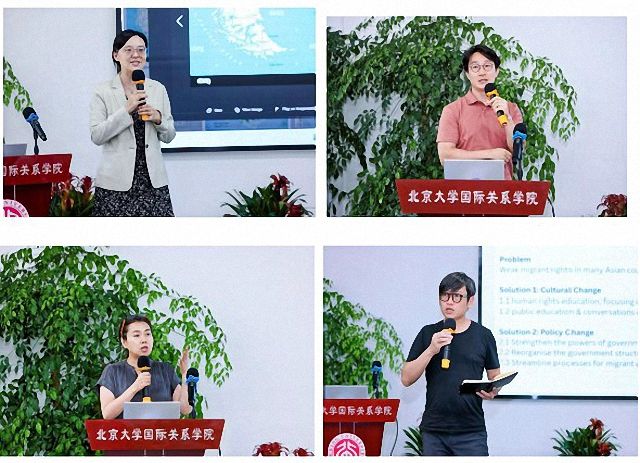
To disseminate knowledge across Asia’s countries and disciplines, the forum invited four distinguished professors from China, Japan, the ROK, and Singapore to analyze critical issues in socially inclusive development from diverse perspectives and to share in-depth insights with students.
In the first lecture, Assistant Professor He Jiani from the School of International Studies at Peking University guided students through the “all-under-heaven” (Tianxia) concept as a framework to explore the world outlook in ancient China and China’s inclusive relationship with the world. Starting with the “One World, One Family” visual narrative of the closing ceremony of the Beijing Olympic Winter Games, she illustrated how the “Tianxia” concept continues to influence contemporary cultural expression and national discourse. She highlighted the concept’s lens for understanding China’s history of foreign relations and its engagement with the world. The lecture inspired students to appreciate how history persistently shapes contemporary Chinese and Asian political imagination based on international relations.

(Figure 2. Assistant Professor He Jiani from the School of International Studies, Peking University)
Associate Professor Jonathan Tan from NTU grounded his presentation in behavioral economics research and analyzed experimental paradigms and cases to elucidate how game-theoretic models illuminate key social inclusion issues, including social norms, mutual trust mechanisms, migrant integration, and cross-cultural innovation. He highlighted that a behavioral experiment is not just an academic research tool but also a useful means to understand real social interactions and evaluate policy effectiveness. He encouraged the students to translate theoretical knowledge into practical solutions and employ innovative perspectives to address the “collective action dilemma” in Asian societies.

(Figure 3. Associate Professor Jonathan Tan from NTU)
In the third lecture, Associate Professor Shukuko Koyama from the Faculty of Social Sciences at Waseda University focused on “Innovative Pathways to Building an Inclusive Society,” showcasing how the Japanese enterprise Heralbony employs a sustainable business model to disassemble disability stereotypes and expand social inclusion for people with disabilities. She actively engaged students, encouraging them to conduct field observation and problem identification based on local accessibility, and proposed a “zero-budget” strategy, enhancing the youth’s capacity to observe and act in inclusive social innovation.

(Figure 4. Associate Professor Shukuko Koyama from the Faculty of Social Sciences, Waseda University)
In the fourth lecture, Professor Nam Kyu Kim from Korea University delved into the game mechanism and the rationalist explanation of interstate conflicts in international relations. Integrating game theory with historical cases, he analyzed the root causes of war, international negotiation mechanisms, and the roles of “deterrence,” “misperception,” and “domestic politics” in interstate conflicts. He stressed that understanding state behavior is fundamental to studying foreign policy and that it is beneficial for young scholars to examine security and challenges in East Asia rationally.
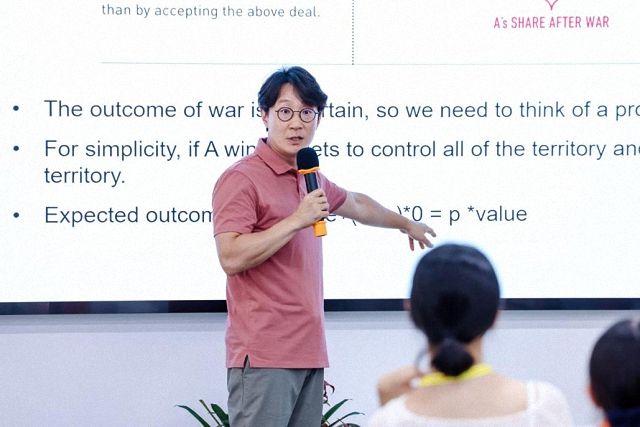
(Figure 5. Professor Nam Kyu Kim from Korea University)
Inherit Past and Usher in Future: Appreciating the “Centrality” and “Harmony” of Beijing Central Axis
In July 2024, UNESCO inscribed “Beijing Central Axis: A Building Ensemble Exhibiting the Ideal Order of the Chinese Capital” on the World Heritage List. This recognition added a world-class cultural landmark to Beijing and established a new platform for global cultural exchange. On the occasion of the first anniversary of the successful inscription of the Beijing Central Axis on the UNESCO World Heritage List, the forum invited Planner Xia Mengchen from the Beijing Municipal Institute of City Planning & Design to deliver a lecture. She explained the temporal and spatial context of the Beijing Central Axis with graphics and text in an easy-to-understand manner, and elucidated the concept and practical approach to protecting and inheriting Beijing’s historical and cultural heritage. A student from NTU commented that the lecture given in a plain and simple way was profoundly impactful and impressive, offering both a macro-level perspective on the major sites along the Axis and a professional deep dive into the intricate details of Beijing.

(Figure 6. Planner Xia Mengchen from the Beijing Municipal Institute of City Planning & Design)
Arranged by the Institute, Chinese and international students visited the Beijing Planning Exhibition Hall and landmarks along the Central Axis, including the Imperial Ancestral Temple, the Altar of Earth and Harvests, the Bell and Drum Towers, and the Beijing Olympic Tower. Among this orderly and magnificent urban architectural complex, formed over seven centuries, they gained insights into the inclusive spiritual beliefs and the unified yet diverse cultural character of traditional Chinese society.
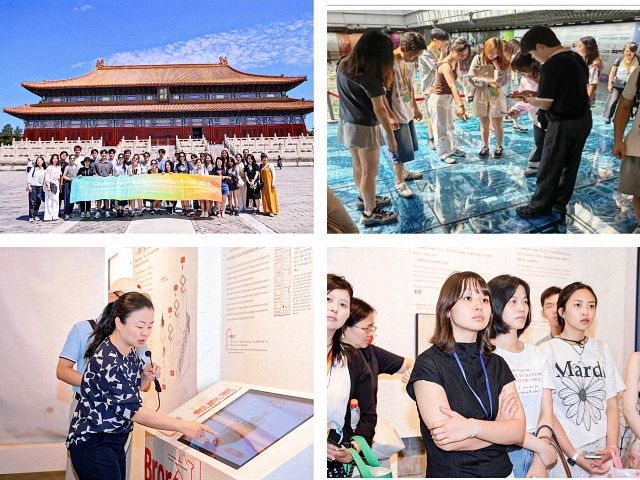
(Figure 7. Onsite Investigations)
At each stop, students meticulously observed historical traces of the Central Axis dating back over 700 years to the Yuan Dynasty and attentively listened to stories of cultural integration among Mongols, Manchus, Han, and other nationalities. At the Beijing Planning Exhibition Hall, systematic exhibits of urban models and historical archives provided a comprehensive understanding of the Axis’s layout, history, preservation mechanisms, and applications as world cultural heritage. The view from the top of the Beijing Olympic Tower offers a unique vantage point, where the dialogue between the historical legacy of the traditional Axis and the modern landscape of its northern extension vividly demonstrates the interplay between cultural heritage preservation and modern development. This perspective highlighted the Axis’s temporal evolution and showcased contemporary China’s inclusive and innovative approach to traditional culture. At the Imperial Ancestral Temple and the Altar of Earth and Harvests, the students gained a better understanding of the ritual structure of “honoring ancestors and venerating lineage” and “heaven, earth, and the state” in the ancient state & ancestral temple system, as well as the architectural pattern of “ancestral temple on the left and altar of land and grain on the right.” They also experienced the visualized Eastern political philosophy in urban space. The continuous revelation of these integrated traditional and modern Oriental cultural elements facilitated an objective, comprehensive, and authentic understanding of Chinese civilization and of the inclusive and diverse Asian civilizations.
Students’ post-visit feedback was positive: “Standing on the Wanning Bridge, I could feel the antiquity and enduring nature of the Central Axis”; “The Imperial Ancestral Temple beautifully represents the ‘family culture’ common across Asia”; “In the Drum and Bell Towers, I perceived genuine Chinese history through time.” The field research deeply impressed them with the cultural significance and aesthetic value of the Central Axis, and how this public space has fostered a collective sense of identity among citizens. The Central Axis is not a static historical relic, but a vibrant thoroughfare connecting ancient imperial administrative offices and ordinary people’s residences, blending traditional charm with contemporary elements, and setting an effective model for inclusive development in cultural heritage transmission and urban spatial planning across Asia.

(Figure 8. Students Locate Landmarks in the Exhibition Hall)
Discussion and Sharing: Youth-driven Solutions for Asian Challenges
In the final presentations, the students delivered group presentations on the topic “Key Challenges in Promoting Inclusive Development in Asian Societies.” Drawing on academic theories and field research materials, they focused on issues such as educational equity, an aging population, youth mental health, and migrant labor. By sharing comparative national experiences, they proposed multiple innovative solutions tailored to the challenges faced by different social groups, achieving holistic, inclusive social progress. The teamwork provided the participants with a comprehensive and profound understanding of social inclusiveness from diverse perspectives and stages.
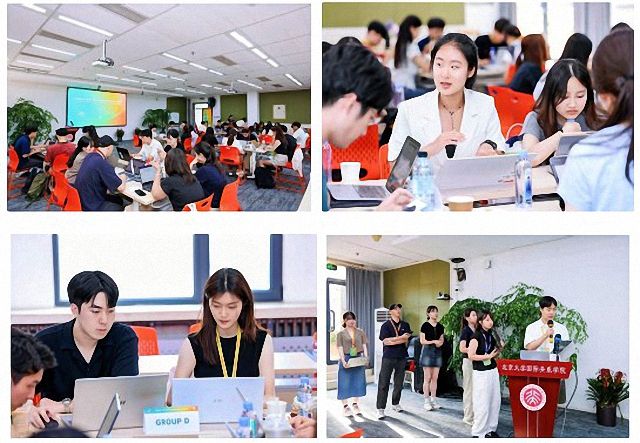
(Figure 9. Group Discussions and Presentations)
Faculty advisors commended the presentations, noting that students from different universities, countries, and cultural backgrounds completed the entire process—from problem identification and situational analysis to cross-national comparison and solution design—within a short time. The group reports demonstrated the youths’ grasp of Asian challenges and the practical potential of Asian solutions, reflecting the critical thinking and action competence of CAMPUS Asia youths regarding social inclusiveness in Asia and underscoring the unique value and collective potential of the new Asian generation in co-constructing an inclusive society.
(Figure 10. Faculty Comments)
Harmonious Coexistence for A Promising Future
Reflecting on the three-day forum, one international student noted, “Previously, I had a general idea of China’s long history, but never understood it that deeply. This event, like a time travel machine, brought me closer to the real China. Understanding it breaks down barriers.”
CAMPUS Asia, spearheaded by the governments of China, Japan, and the ROK, has evolved over the past decade into a flagship initiative in trilateral higher education. The Joint Declaration of the Ninth ROK-Japan-China Trilateral Summit emphasized that people-to-people exchanges among youths enhance mutual understanding and trust, foster neighborly relations, and lay a foundation for future cooperation. Over the three days, youths from China, Japan, the ROK, and ASEAN countries engaged with effective practices in building inclusive societies across Asia, enhanced understanding through exchange, sparked ideas through discussion, and built consensus through collaboration.

(Figure 11. Group Photo)
In Beijing, a city blending antiquity and modernity, Asian youths transcended cultural boundaries with open and inclusive mindsets, focused on common challenges, and jointly created a blueprint for inclusive cooperation in Asia. This cross-cultural dialogue of ideas built a bridge of understanding and collaboration and showcased the overwhelming energy and limitless potential of Asian youths in driving social innovation and sustainable development.
Contributor: Chang Jiayi
Photographers: Tong Junjie, Chang Jiayi
Editors: Chen Fang, You Zhuang